


Something strange happens when every brand learns to speak fluently.
At first, it feels like progress.
The homepage sounds cleaner.
The social posts sound sharper.
The pitch deck sounds more confident.
The product description no longer feels like it was written at midnight by a founder who had opened too many browser tabs.
Everything improves.
The sentences become smoother.
The grammar behaves.
The tone becomes professional.
The message becomes clear enough.
The brand starts using words like “seamless,” “empower,” “elevate,” “unlock,” and “transform” with the confidence of someone who has never had to explain what they actually mean.
And for a moment, it feels like the work is better.
Then you read it again.
Nothing is wrong.
That is the problem.
There is no awkwardness.
No edge.
No memory.
No strange little detail that makes you feel a real person was there.
It sounds polished.
But it does not sound alive.
The problem is no longer bad content
For a long time, brands had an obvious problem.
They sounded bad.
The copy was unclear.
The design was inconsistent.
The messaging was too long.
The visuals felt outdated.
The website looked like five different people had argued with each other and everyone lost.
AI has helped with some of that.
It can clean things up.
It can make rough ideas presentable.
It can help a small team move faster.
It can turn a messy paragraph into something readable.
It can create a first version of almost anything.
That is useful.
Very useful.
But now we are entering a different problem.
The problem is not that brands sound terrible.
The problem is that many brands are starting to sound the same kind of good.
Smooth.
Helpful.
Positive.
Professional.
Pleasant.
Completely forgettable.
The internet is becoming over-lit.
Everything is bright.
Everything is clean.
Everything has good spacing.
Everything says the right thing in the right tone.
And somehow, a lot of it feels less human.
Because human does not mean perfect.
Human means specific.
A human brand is not just a friendly brand
This is where many companies get confused.
They think making a brand feel human means making it casual.
So they add emojis.
They write in lowercase.
They say “Hey there.”
They make jokes in the error message.
They call every customer a “friend.”
They add a little wink to the button copy.
Sometimes that works.
Often, it does not.
Because friendliness is not the same as humanity.
A brand can be friendly and still feel fake.
A brand can be formal and still feel deeply human.
Humanity is not a tone setting.
It is not a sprinkle of warmth added at the end.
It is the feeling that there is a real point of view behind the words.
A real reason for existing.
A real understanding of the customer.
A real standard for what belongs and what does not.
A real memory of why the company started.
A real willingness to sound like itself, even if that means not sounding like everyone else.
That is what people feel.
Not consciously at first.
They may not say, “This brand lacks specificity.”
They just leave.
Or they forget.
Or they think, “This looks fine,” and open another tab.
Fine is a dangerous place to live.
It is comfortable.
It is also invisible.
AI can give your brand a voice. It cannot give it a memory.
A brand is not just how you speak.
It is what you remember.
The first customer who trusted you before your product was ready.
The mistake that changed how you work.
The sentence your clients keep repeating.
The frustration that made you start.
The small detail everyone else ignores.
The thing you refuse to compromise on.
The kind of work you do not want to become known for.
These things shape a brand.
They create texture.
AI can help you express them.
But it cannot invent the lived truth underneath them.
It can generate a founder story.
But it does not know which part of your story still hurts a little.
It can write your About page.
But it does not know the moment you almost gave up.
It can create a brand voice.
But it does not know the kind of client you are quietly trying to attract, or the kind you have learned to avoid.
It can make your message sound confident.
But it does not know what you have earned the right to say.
That matters.
Because trust is not built only from clarity.
Trust is built from proof.
And some proof is emotional.
The reader feels that the words came from somewhere real.
Generic brands hide behind perfect words
There are certain words that appear when a brand has not made a sharper decision yet.
Unlock.
Empower.
Elevate.
Transform.
Seamless.
Future-ready.
Game-changing.
End-to-end.
Innovative.
Scalable.
These words are not evil.
Sometimes they are useful.
But they are often used as fog.
They make a sentence feel important while protecting it from becoming specific.
“We empower teams to unlock seamless growth.”
It sounds like something.
But what does it mean?
Who is the team?
What kind of growth?
What was hard before?
What changed after you arrived?
Why should anyone believe you?
The more AI writes for brands, the more fluent this fog becomes.
It will not sound broken.
It will sound clean.
That is what makes it dangerous.
Bad copy is easy to reject.
Polished nothingness is harder.
It looks responsible.
It sounds professional.
It passes through meetings without making anyone uncomfortable.
But it does not make anyone care.
A human brand is willing to be clearer than that.
It says the actual thing.
Not the impressive thing.
The actual thing.
The human parts are often the imperfect parts
Most brands want to look complete.
That is understandable.
No founder wants their company to feel messy.
No team wants to look uncertain.
No business wants to admit that the thing they now do well was once confusing, painful, or badly understood.
So the story gets cleaned.
The rough edges disappear.
The origin becomes polished.
The language becomes safer.
The promise becomes broader.
The personality becomes acceptable.
And slowly, the brand becomes less believable.
Because people do not only trust confidence.
They trust earned confidence.
There is a difference.
Unreal confidence says:
“We are the leading solution for modern teams.”
Earned confidence says:
“We built this because the old way wasted too much time, created too much confusion, and made good teams feel slower than they were.”
One is polished.
The other has a reason.
The human parts of a brand are often the parts that AI tries to smooth away.
The weird origin.
The strong opinion.
The specific frustration.
The unusual process.
The thing that does not fit neatly into a template.
The sentence that sounds a little too direct but finally says what everyone means.
Those are not flaws.
Those are fingerprints.

A brand needs a fingerprint
A fingerprint is small.
It is not loud.
It does not announce itself with a slogan.
But it proves that something real touched the work.
Brands need that now.
Not more decoration.
Not more generated content.
Not more polished sameness.
A fingerprint.
A way of speaking that feels specific.
A way of designing that feels intentional.
A way of choosing images that does not feel like stock.
A way of explaining the offer that sounds like it came from experience.
A way of saying no.
Because a brand is shaped as much by what it refuses as by what it includes.
It refuses the wrong tone.
It refuses the wrong client.
It refuses the lazy headline.
It refuses the trendy visual that does not belong.
It refuses to sound bigger, cooler, or more magical than it actually is.
This is not easy.
AI makes it very tempting to accept the version that sounds most complete.
But complete is not always right.
Sometimes the best brand sentence is simpler.
Sometimes it is quieter.
Sometimes it sounds almost too plain until you realize it is the only sentence that is true.
Average brands try to sound impressive. Human brands try to be understood.
Here is a useful way to think about it.
Average brands explain what they do.
Human brands reveal why it matters.
Average brands sound polished.
Human brands sound specific.
Average brands borrow category language.
Human brands create their own rhythm.
Average brands try to appeal to everyone.
Human brands are brave enough to be remembered by the right people.
Average brands add more words when the message feels weak.
Human brands sharpen the sentence until it carries weight.
Average brands say, “We care.”
Human brands show where the care went.
That last one matters.
Care is visible.
It shows up in the way a page is structured.
In the way a button is named.
In the way a complex service is explained simply.
In the way a brand chooses not to exaggerate.
In the way a company speaks to a tired customer with respect instead of noise.
People can feel that.
They may not analyze it.
But they feel it.
The more content we generate, the more silence we need
This may sound strange for a blog about branding.
But a lot of human feeling comes from restraint.
A pause.
A shorter sentence.
A page that does not try to say everything at once.
A brand that does not fill every empty space because it is afraid of being misunderstood.
AI can produce endlessly.
That is its gift.
It can give you ten headlines.
Twenty taglines.
Fifty social posts.
A full content calendar.
A campaign system.
A homepage.
A newsletter.
A pitch deck.
A product explainer.
There is no shortage of output anymore.
The shortage is attention.
And attention does not grow just because content grows.
In fact, the opposite may happen.
The more the internet fills with generated words and images, the more valuable it becomes to say less, but mean more.
Human brands understand this.
They do not confuse frequency with presence.
They do not speak just because they can.
They speak when they have something worth saying.
The danger is not that AI will make brands robotic
That is too obvious.
The real danger is subtler.
AI may make brands sound pleasantly human in exactly the same way.
Warm, but not specific.
Confident, but not earned.
Clear, but not memorable.
Friendly, but not intimate.
Professional, but not alive.
A robot voice is easy to reject.
A polished almost-human voice is harder.
It sounds close enough.
That is why the next era of branding will require more care, not less.
Not because AI is bad.
Because AI is powerful.
Powerful tools increase the responsibility of the person using them.
A camera can capture anything.
That does not make every photograph meaningful.
A design tool can create any layout.
That does not make every page trustworthy.
An AI writing tool can produce any tone.
That does not make every voice believable.
The tool can make the thing.
But the brand has to carry the truth.
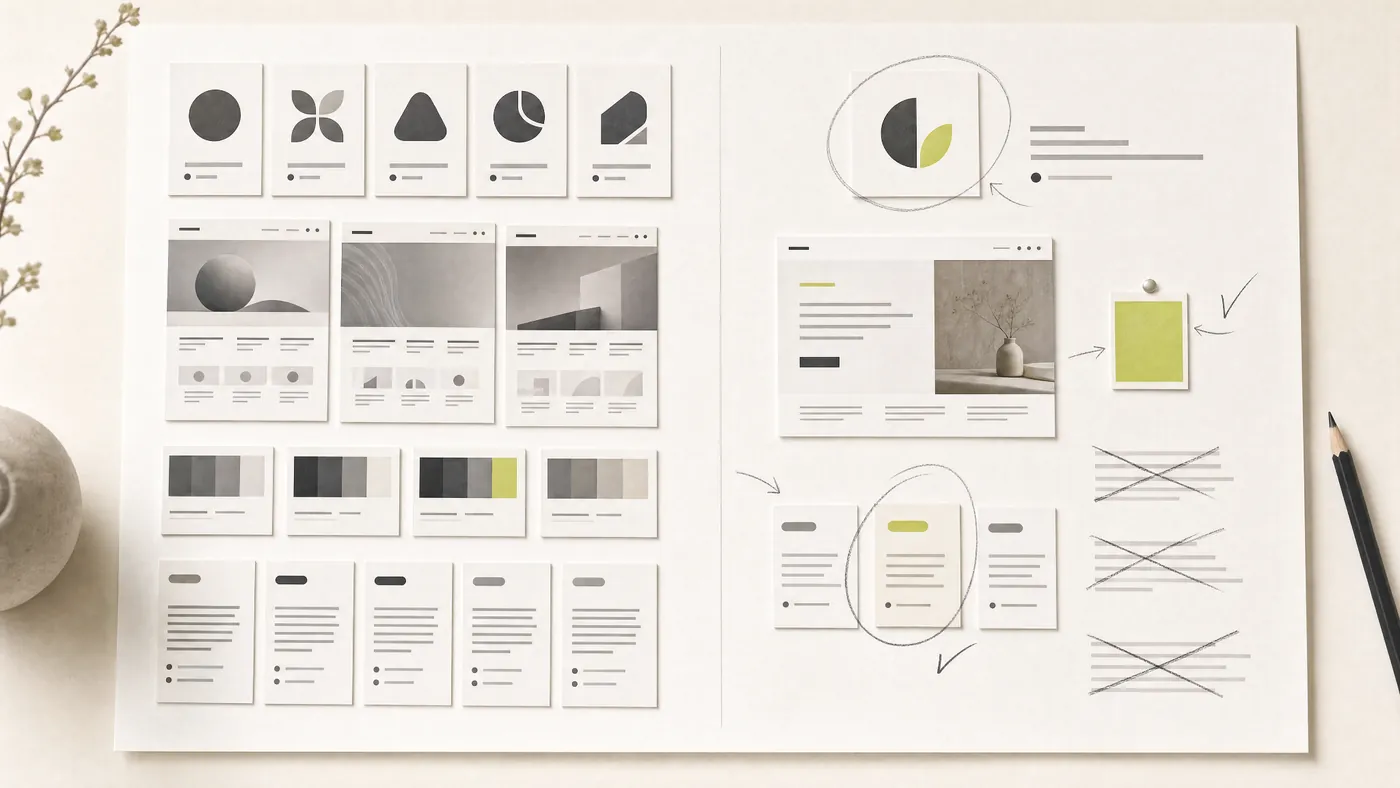
At Allgood Studio, we use AI to move faster, not to become flatter
We use AI in our process.
Not secretly.
Not reluctantly.
It helps us explore directions faster.
It helps us shape rough ideas earlier.
It helps us test visual and verbal options.
It helps us move from blank page to first draft without wasting time on mechanical work.
That speed is valuable.
But we do not treat AI output as the brand.
We treat it as material.
Something to question.
Something to edit.
Something to push against.
Something to make more specific.
The real work still happens in the decisions.
Which sentence feels honest?
Which visual belongs?
Which layout creates trust?
Which detail makes the company feel real?
Which claim has proof behind it?
Which part should be removed because it only sounds good?
That is where the brand becomes human.
Not in rejecting AI.
In refusing to let AI flatten the work into something that could belong to anyone.
Human-led.
AI-assisted.
Not because it sounds nice.
Because in this new world, that is where the strongest work lives.
Between speed and care.
Between output and judgment.
Between what can be generated and what should be believed.
The future belongs to brands that feel real
People are tired.
Not just busy.
Tired.
Tired of being sold to.
Tired of vague promises.
Tired of perfect words with nothing behind them.
Tired of brands that sound like they were assembled from the same invisible kit.
They may not always know what they want.
But they can feel what they do not trust.
They can feel when a brand is hiding behind polish.
They can feel when a message has no spine.
They can feel when a company is trying to sound important instead of useful.
They can feel when nobody really looked at the work before it went live.
And they can feel the opposite.
A sentence that sounds true.
A design choice that feels considered.
A page that respects their time.
A brand that knows what it is and what it is not.
That is rare.
It will become rarer.
As AI generates more, the brands that stand out will not be the ones with the most content.
They will be the ones with the clearest humanity.
The ones with a fingerprint.
The ones that feel touched, not just produced.
Because the more the internet learns to generate, the more people will look for proof that someone was really there.
Written by Allgood Studio.
Human-led design, AI-assisted speed, and careful hands for brands, websites, and digital products.